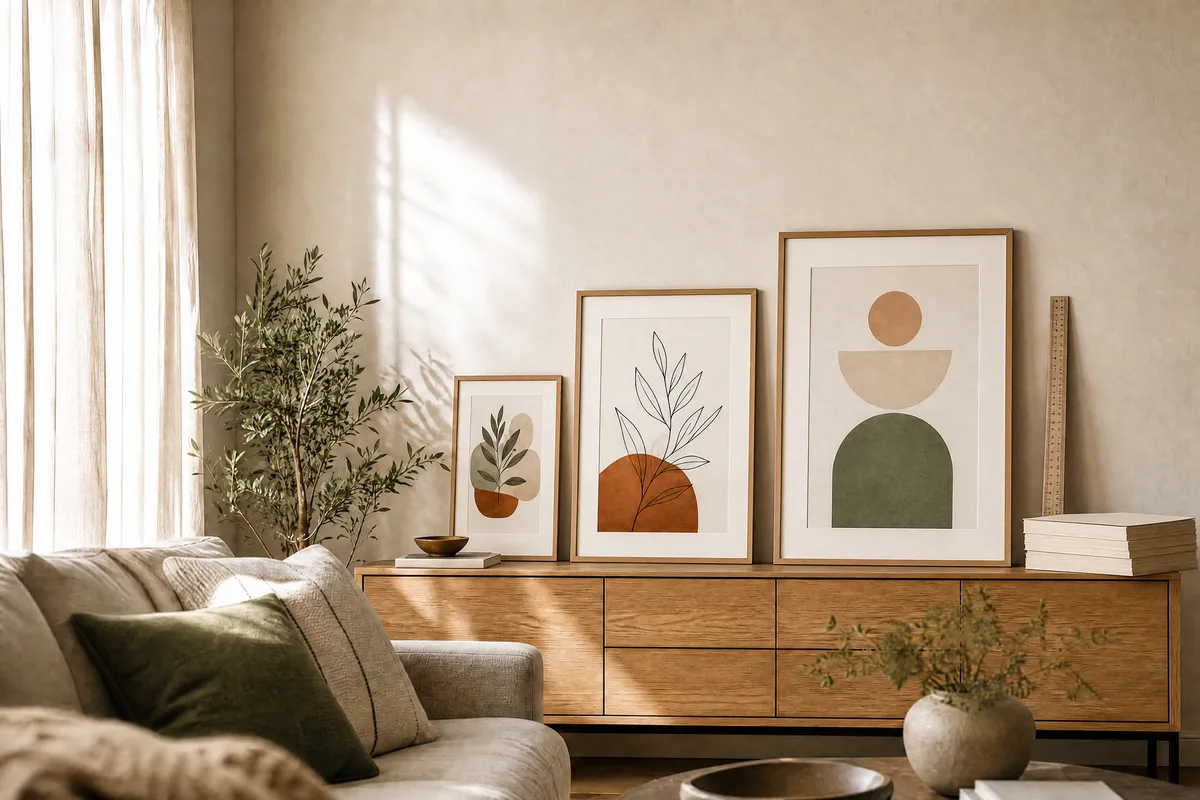
Printable art is the rare corner of home decorating where the affordable option and the good option are the same thing. You buy a file once, you can print it at any size the file supports, reprint it if it fades or you move house, and swap it out seasonally without guilt. But the gap between “downloaded a JPG” and “framed piece that looks intentional on the wall” is exactly four decisions: size, paper, printing method, and placement. Let’s take them in order.
What sizes should I print wall art in?
Almost every frustration with printables traces back to aspect ratio — the proportion of width to height. A file designed at 2:3 will not fill a 4:5 frame without cropping or white borders. So before you fall in love with a frame, check which ratio family your file belongs to. Most shops (ours included) supply each artwork in several ratios so every common frame is covered.
Here are the standard print sizes, grouped by ratio:
| Ratio | US sizes (inches) | Metric / EU sizes |
|---|---|---|
| 2:3 | 4x6, 8x12, 12x18, 16x24, 20x30, 24x36 | 10x15 cm, 20x30 cm, 30x45 cm, 40x60 cm, 50x75 cm |
| 3:4 | 6x8, 9x12, 12x16, 18x24 | 15x20 cm, 30x40 cm, 45x60 cm |
| 4:5 | 8x10, 11x14 (close), 16x20 | 20x25 cm, 40x50 cm |
| 5:7 | 5x7 | 13x18 cm |
| ISO A (1:1.414) | — | A5, A4, A3, A2, A1 |
| 50x70 | — | 50x70 cm (the classic European poster frame) |
Two practical notes on that table. First, ISO A sizes (A4, A3, A2) are the everyday standard in Europe — an A4 print costs pennies at home, and A-series frames are in every IKEA and department store. Second, 50x70 cm sits in no US ratio family at all; if you want that big Scandinavian-poster look, make sure the file explicitly includes a 50x70 version.
Which size for which wall?
| Wall spot | Recommended print size |
|---|---|
| Small shelf, desk, or narrow wall slice | 5x7 in / A5 / 13x18 cm |
| Bathroom, hallway, kitchen nook | 8x10 in / A4 / 21x30 cm |
| Above a dresser or console | 11x14–16x20 in / A3 / 30x40 cm |
| Above a sofa or bed (single piece) | 24x36 in / 50x70 cm / A2 or larger |
| Gallery wall | Mix of 5x7, 8x10, and 11x14 (or A5/A4/A3) |
A single small print floating on a big empty wall is the most common mistake we see. When in doubt, go one size up — or use a set of three to build width without a huge single frame.
What paper should I print wall art on?
Paper does more for perceived quality than resolution does. The short version: matte, 180–250 gsm is the safe default for almost all art styles.
| Paper type | Weight | Best for | Watch out for |
|---|---|---|---|
| Matte photo/presentation paper | 180–230 gsm | Illustrations, botanicals, typography, kids’ art | The all-rounder; hard to get wrong |
| Luster / satin | 200–260 gsm | Photography, rich dark artwork | Slight sheen can glare behind glass |
| Glossy | 200–260 gsm | Almost nothing framed | Fingerprints, heavy glare under glass |
| Cotton rag / fine art | 250–310 gsm | Statement pieces, gifts, charcoal and watercolor styles | Costs several times more; worth it for hero pieces |
| Cardstock | 200–300 gsm | Budget prints, seasonal swaps | Thinner color depth than coated photo paper |
Glossy paper is the one to actively avoid for framed art: glass already adds reflection, and gloss doubles it. If your print will hang unframed (clipboards, washi tape, poster hangers), a heavier stock matters more because the paper itself is on display — go 250 gsm or above so it hangs flat.
Should I print at home or at a print shop?
Both are legitimate; they just win in different situations. Home printing wins on speed and cost for A4/8x10 and smaller, especially on an inkjet with a fresh set of cartridges and proper matte paper. Print shops and online labs win from A3/11x14 upward, for dark and color-saturated artwork, and any time the piece is a gift. We wrote a full honest comparison with real costs in our print at home vs print shop guide — the one-line summary is: small prints at home, big or dark prints at a lab.
How do I frame printable art?
The economics of printables get even better here, because standard-size prints fit standard-size frames — and standard frames are cheap. A few rules that consistently pay off:
Match the print to an off-the-shelf frame size before printing. Check the frame aisle first (or your existing frames), then print to fit. This is far easier than hunting a frame for an odd-sized print.
Use a mat for instant polish. A print matted inside a larger frame — say an 8x10 print in an 11x14 frame with a mat — reads noticeably more finished than the same print edge-to-edge. Many frames now come with the mat included.
Keep frames quiet, let the art speak. Thin black metal, natural oak, or white are the three finishes that work with nearly everything. If you’re building a gallery wall, repeating one or two frame finishes ties mixed artwork together.
Don’t fear glass-free options. Poster hangers (two wooden rails and a string) suit large prints and cost a fraction of a big frame; they also remove glare entirely.
How high should I hang wall art?
Use the gallery standard: the center of the artwork at 145 cm (57 inches) from the floor — average eye level. This single rule fixes the most common hanging error, which is placing art too high.
Adjustments for furniture: above a sofa, bed, or console, ignore the eye-level rule and instead leave 15–25 cm (6–10 inches) between the furniture and the frame’s bottom edge, so the art visually connects to the piece below it. For a grouping, treat the whole cluster as one artwork and center the cluster at 145 cm, keeping 5–8 cm between frames.
What about gallery walls and sets?
Sets are the shortcut to a designed-looking wall: pieces that already share a palette and mood remove the hardest part of gallery-wall planning. Lay everything on the floor first, start from the center piece, and work outward. Paper templates taped to the wall (trace each frame, tape up, hammer through) save both nerves and plaster.
If you’d rather start from a matched set than assemble one, this is where we point to ourselves, plainly: our own shop Linoraprint sells printable sets designed as ready-made gallery walls, alongside single prints. Etsy at large, independent artist shops, and museum open-access collections (The Met, Rijksmuseum, and the Art Institute of Chicago all offer free high-resolution downloads of public-domain works) are equally good hunting grounds — the sizing, paper, and hanging rules above apply identically wherever the file comes from.
Pin this guide
Save it for your next printing session — the size charts alone are worth keeping.
Pin 1 of 2 — save to Pinterest 
Pin 2 of 2 — save to Pinterest